

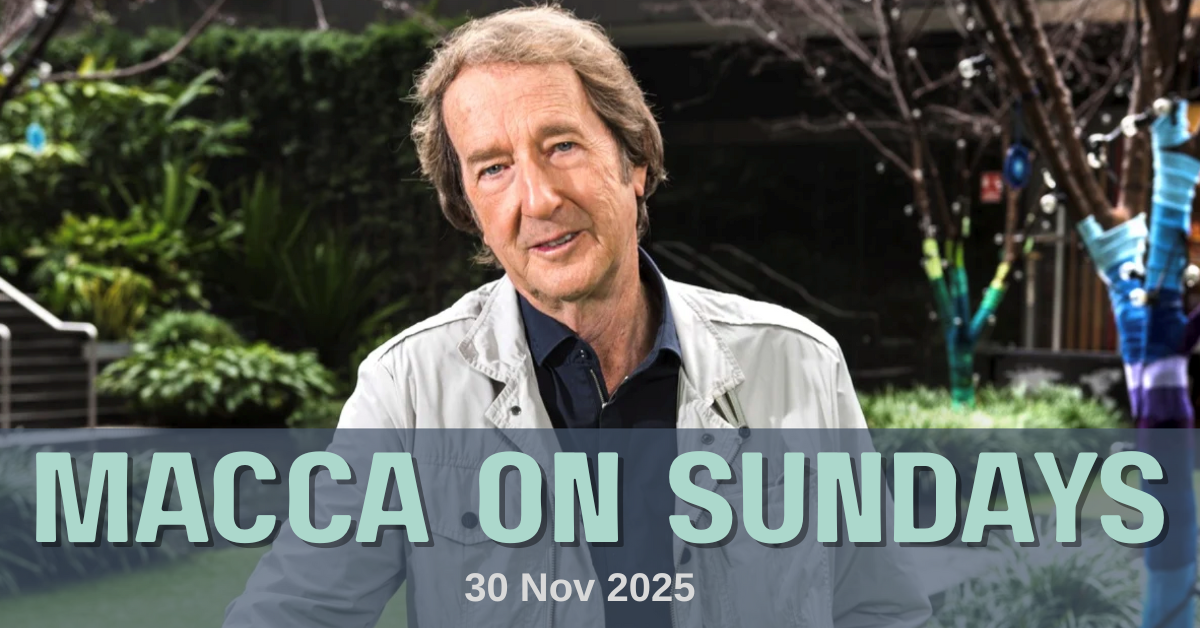

Ordinary Lives, Extraordinary Threads: This Week in the Australian Phone Box
Some Sundays arrive like a deep breath — not loud, not polished, just steady. A man pulls over on a long inland road because a stranger’s dog has fallen out of a ute. A tug skipper in Port Hedland talks horsepower and tides like it’s poetry. A daughter keeps watch over the last of the Bomber Command generation, while another quietly reminds us that planes didn’t fly on bravery alone — they flew because people on the ground made sure they could. And threaded through it all are small acts that don’t ask for applause, but somehow hold a country together.
Bruno, the Ute, and the Kindness You Don’t Forget
Stibbsie from Charters Towers told the kind of outback story that starts as a favour and ends as a legend. Years ago, fuelling up at the Belyando Roadhouse, a bloke asked him to keep an eye out for his dog, Bruno — who’d fallen out of a cage on the back of the ute. There was a crumpled phone number. A tenner pushed into a shirt pocket. And the sort of request you can’t quite shake, even when you drive off.
Days later, a surveyor mate rang: he’d found a dog in the scrub — not looking flash — and could Stibbsie pick him up and get him to a vet? He drove out, taped Bruno’s mouth just in case, and loaded him like dead weight into the tray. But a kilometre down the road, Stibbsie looked back: Bruno was standing up on the ute like he owned it — tongue out, wind in his face, thrilled to be moving again.



At the vet, Bruno jumped down, walked in like a regular, and was declared basically fine — maybe just hungry. Owner reunited. A $150 reward offered and accepted, then shared with the mate who’d made the call. A happy ending — and a reminder that sometimes the biggest moments happen on the side of a highway, between people who’ll never be famous, but do the right thing anyway.
Port Hedland, Big Ships, and a Tug That Pushes the World Around

In Port Hedland, Macca spoke with Andrew Colliver — master of a harbour tug, the Boodarie — 27 metres long, 5,000 horsepower, built for the slow, precise work of moving enormous ships in and out. Across the way were 300-metre bulk carriers, loading around 200,000 tonnes of iron ore at a time.

Andrew grew up in Shark Bay, started in dinghies, moved into fishing boats, then spent years on prawn trawlers before shifting into tug work and offshore oil-and-gas support on the North West Shelf. He spoke about tides like they were alive — because in a place like Port Hedland, they are. You don’t move ships unless the water’s there.

It turned a headline industry into something human: one bloke in a wheelhouse, quietly doing a job that keeps the nation’s exports moving.
The Bomber Command Families, and the People Who Kept Them Flying
Annette Gutierrez called with a quiet mission: to help identify how many Australian Bomber Command veterans are still alive following the death of Joffre Bell in Queensland at the age of 105. Her understanding was that there may be as few as a dozen remaining, including centenarians who recently attended a Bomber Command luncheon in Sydney, and at least one widow aged 100. Records are incomplete, and many families don’t note service details in death notices. Her hope was simply that their service be acknowledged while it still can be.
Ian from Huntleys Cove then shared a fresh loss. His father-in-law, Philip Smith, had died in Burradoo just a month short of his 102nd birthday. Philip was a wireless operator on Lancaster bombers — modest, private, but willing to share his logbooks and memories so his granddaughter could complete her final-year history assignment. Not for recognition — just because the story mattered.



Lynne from Bowral widened the lens again. Her mother, Betty — now 102 and living independently in Logan Village — worked as an electrician during the war at RAAF Base Sale, maintaining aircraft. Lynne’s point was simple and powerful: the planes didn’t stay airborne on courage alone. They flew because people like Betty kept them airworthy — and when the war ended, many women were told there was no place for them in the trade. Betty retrained as a hairdresser. Life moved on. The contribution remained.
A Veggie Garden for Mum, and the Everyday Work of Love
Bill rang from near Ebor, on his way to Port Macquarie with tools in the car and a plan: to build a vegetable garden for his 93-year-old mum. Not as a grand gesture — but as a way to keep her interested, active and connected. Tomatoes. Beans. Rhubarb for a proper rhubarb-and-apple pie. Neighbours helping out. Home support keeping the rhythm of her days.
He spoke about his mum still getting on her hands and knees to weed, moving through a three-storey home fitted with a lift, determined to keep living life on her own terms. It wasn’t really about vegetables. It was about dignity.
“Kerosene Blue” Water in the Torres Strait
Out on the water near Yam Island, Gossie called from the Cape Graft, now operating as a mothership for the start of the free-diving crayfish season. He borrowed a phrase from a local Islander to describe the conditions: “kerosene blue” — flat, calm, beautiful.
Free-diving would run through December and January, with hookah diving beginning later in the year. The catch would head south to market. It was work, yes — but the way he described it, it sounded like a place you could breathe.
The Electric Toothbrush and the Bee Problem
Andy from Millongandy offered a bush solution to a worrying observation: fewer bees around the garden. His tip was practical and oddly ingenious — using an electric toothbrush (with the head removed) to gently vibrate tomato or capsicum flowers, mimicking the action of bees and helping pollination.
It was funny — but also quietly sobering. Because the trick only works if bees aren’t there to do the job themselves.
Forty-Two Marathons for the Fallen
Susan Chuck shared the story of a Brisbane serviceman, Ben Sedonari, who ran a marathon every day for 42 consecutive days, finishing at the Afghanistan Memorial near Suncorp Stadium. The effort honoured those lost to conflict, injury, and suicide, raising close to $14,000 for veterans’ support.
It sounded impossible — until he simply did it. One day at a time.
On the Road: Ammonium Nitrate and the Long Haul
Alan called from the cab of his truck, travelling from Moree to Gladstone to load ammonium nitrate, then north toward a mine near Collinsville. A V-double. Long hours. Roads that range from good to rough.
He didn’t romanticise the work. Trucking is something you either settle into or move on from. Before hanging up, he asked if Macca might ever do caps for truckies — a small request, but one that spoke to the desire to feel part of something larger than the road ahead.
Neville’s 26-Year “Three Months to Live”
Neville’s call carried quiet resilience. Diagnosed with multiple myeloma in 1999 and given just months to live without treatment — and perhaps four years with it — he was still here 26 years later. He’d recently finished restoring a 1949 Riley sedan and was already planning the next project.
His outlook was simple and earned: you get nothing out if you put nothing in.
AI Music, Real Music, and the Live Thing
The conversation drifted into AI-generated music, sparked by Charlie, an Uber driver from Cairns who’d been experimenting with AI songwriting tools. Some callers loved the sound and the feeling it created, regardless of how it was made.
Adrian from Tully Heads — a conductor and arranger — offered the counterpoint. His concern wasn’t novelty, but what gets lost: musical literacy, craft, and the human emotion that lives inside performance. An AI song might be clever, he said — but it isn’t human.
Macca brought it back to something stubborn and old-fashioned: live music still matters. A room full of people hearing sound move through air is something no algorithm can replace.
Milano–Cortina, Snowboard Cross, and the Team Behind the Team
Justin from Sydney explained snowboard cross — four riders launching together down a course of jumps, berms and bumps. Strategy, timing and controlled aggression matter as much as speed.
A physiotherapist with the Australian snowboard cross team, Justin spoke about preparing for the Milano–Cortina Winter Olympics, beginning in February 2026. He described the injuries viewers never see — fractured spines, complex recoveries — and the challenges of treating athletes in cold, remote conditions.
Behind every Olympic moment, there’s a team quietly holding things together.
Borroloola Storm Clouds, Crocodiles, and a New Cyclone Shelter
From Borroloola in the Gulf Country, Samuel described wet-season skies building with thunder and lightning — and welcomed news that a long-awaited cyclone shelter had finally been completed, large enough to hold around 500 people.
He also spoke plainly about crocodiles. Numbers are higher now than decades ago, and living alongside them means lost nets, closed swimming holes, and constant awareness. There was no panic in his voice — just respect.
Cans in the Todd River and Paying for Christmas Lunch
Cameron from Alice Springs shared a tradition he and his wife had built: walking the Todd River collecting cans and bottles. Over time, they gathered more than 3,000 — about $300 worth — enough to pay for Christmas lunch at a local resort.
He spoke about cicadas emerging, kingfishers hunting, and the difference between passing through a place and actually living there. In passing, he mentioned his father’s wartime work on G for George at RAAF Base Amberley — and how long recognition can sometimes take to catch up with service.
Richmond’s School of Arts and the Power of Live Music
Dave — usually based in Gove, temporarily on the Sunshine Coast — rang after spotting Macca’s image on the side of the Richmond School of Arts, promoting a Christmas fundraiser concert. He spoke fondly of the hall: its acoustics, its history, and the way music sounds when it’s played properly in a room built for it.
The call drifted through memories of Richmond, community halls, and nights when live music reminds you the world still fits together.
A Sailor’s Shock: Remembering Cookie
Andy from Port Lincoln rang with heavy news. The local sailing community had lost one of its most free-spirited members, Deidre “Cookie” Sibley, while she was aboard a French-flagged yacht in waters off East Africa.
An automatic distress signal was triggered. When the vessel was later boarded, two people were found deceased. At the time of the call, the circumstances remained unclear. Cookie was remembered as fit, fearless and generous — a PE teacher, diver and sailor who helped visiting yachties find moorings and feel welcome.
It was the kind of story that leaves a long silence behind it.
Over-65 Cricket, Christchurch, and Old Mates Reappearing
James from Hobart wrapped the morning with cricket. Tasmania’s over-65s had travelled to Christchurch for the Australasian Championships. With a small playing pool, they finished seventh — but won a match, made friends, and relished the camaraderie.
Four games in five days took their toll. But the moment that mattered most came when James found himself bowling to a former schoolmate from Lismore — decades after they’d last shared a field.
Life, quietly, had folded back on itself.
Ordinary People From All Over Australia
That’s the strange, beautiful rhythm of a Sunday morning phone line. The country arrives in fragments — a garden bed, a tug’s engine room, a war story carried carefully, a marathon measured out day by day. And when the calls fade, what lingers is the sense that Australia is still held together the way it always has been — by ordinary people, from all over the country, doing what they do, and doing it with heart.
Listen to the podcast episode here.
Disclaimer: ‘Australia All Over’ is a program produced and broadcast by the ABC Local Radio Network and hosted by Ian McNamara. Brisbane Suburbs Online News has no affiliation with Ian McNamara, the ABC, or the ‘Australia All Over’ program. This weekly review is an independent summary based on publicly available episodes. All original content and recordings remain the property of the ABC. Our summaries are written in our own words and are intended for commentary and review purposes only. Readers can listen to the full episodes via the official ABC platforms.